Home Physics Motion in a Plane Kinematics of Circular Motion The length of second ’ s hand in a watch is …
Physics Motion in a Plane Kinematics of Circular Motion Subjective Type
Published on: September 12, 2026

The length of second ’ s hand in a watch is 1 cm. Find the magnitude of change in velocity of its tip in 15 seconds. Also find out the magnitude of average acceleration during this interval

Share this question

For Instagram sharing, use “Apps” on mobile or copy the link.

Text Solution

Verified by Experts
The correct answer is:
A
Step 1: Determine the initial and final velocities of the tip of the second's hand.
The second's hand rotates in a circle with a radius of 1 cm. The angular velocity of the second's hand, which completes one full revolution in 60 seconds, is given by:
$$\omega = \frac{2\pi \text{ rad}}{60 \text{ s}} = \frac{\pi}{30} \text{ rad/s}$$
Step 2: Calculate the velocity (v) of the tip at any instant using the formula:
$$v = r \cdot \omega$$
where r is the radius (1 cm or 0.01 m). Thus,
$$v = 0.01 \text{ m} \cdot \frac{\pi}{30} \text{ rad/s} = \frac{\pi}{3000} \text{ m/s}$$
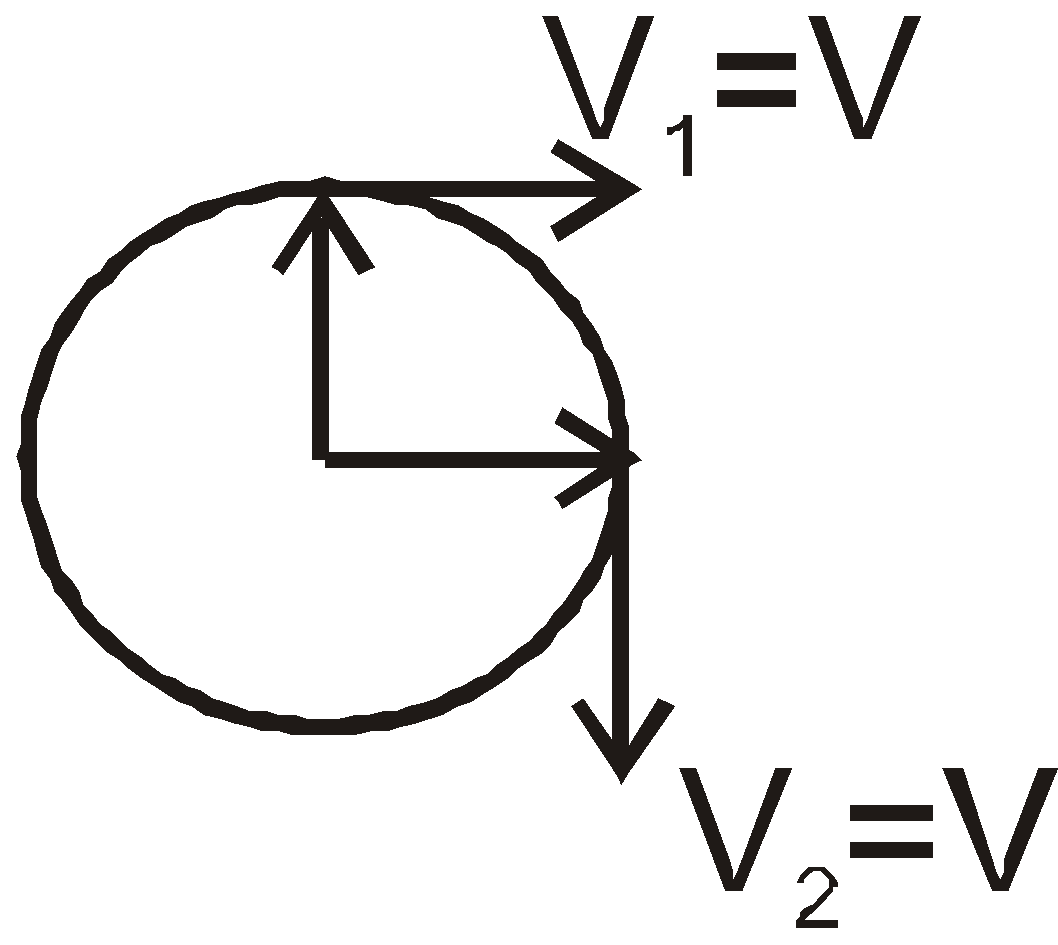
Step 3: After 15 seconds, the hand completes a half revolution (180 degrees or π radians), resulting in a change in direction of the velocity vector, while the speed (magnitude of velocity) remains the same.
Initially, the velocity vector can be taken as pointing to the right (0 degrees) and after 15 seconds, it points directly downward (180 degrees).
Step 4: The change in velocity can be calculated using the formula for change in vector quantities:
Let $$\vec{v_1} = \frac{\pi}{3000} \hat{i}$$
and $$\vec{v_2} = -\frac{\pi}{3000} \hat{j}$$
The change in velocity $$\Delta \vec{v} = \vec{v_2} - \vec{v_1} = -\frac{\pi}{3000} \hat{j} - \frac{\pi}{3000} \hat{i} = -\frac{\pi}{3000} (\hat{i} + \hat{j})$$
The magnitude of change in velocity is:
$$|\Delta \vec{v}| = \sqrt{\left(-\frac{\pi}{3000}\right)^2 + \left(-\frac{\pi}{3000}\right)^2} = \frac{\pi}{3000}\sqrt{2}$$
Step 5: Now, calculate the average acceleration during this interval:
Average acceleration ($a_{avg}$) is given by:
$$a_{avg} = \frac{\Delta v}{\Delta t}$$
where $$\Delta t = 15 s$$. Thus,
$$a_{avg} = \frac{|\Delta \vec{v}|}{15}\text{ s} = \frac{\frac{\pi}{3000}\sqrt{2}}{15} = \frac{\pi \sqrt{2}}{45000} \text{ m/s}^2$$
Final Result:
Magnitude of change in velocity: $$\frac{\pi}{3000}\sqrt{2} \text{ m/s}$$
Magnitude of average acceleration: $$\frac{\pi \sqrt{2}}{45000} \text{ m/s}^2$$.

Prepare Smarter with CGP Edu

Get practice questions, solutions, and test series in one place.

Write a Review

Share your experience with this question and solution.

Commentary

Send your comment, doubt, correction, or feedback to admin.

Student Reviews

What students say about this solution

No reviews yet. Be the first to write a review.

Similar Questions

Explore conceptually related problems

CG
CGP Question Assistant Question Bank + AI Help
Hi! Type your question or upload one screenshot. First I will search related questions from CGP Edu Question Bank. If none match, type YES and I will solve it with AI.
Upload only one screenshot at a time. Flow: Question Bank first → If not matched, type YES for AI solution.